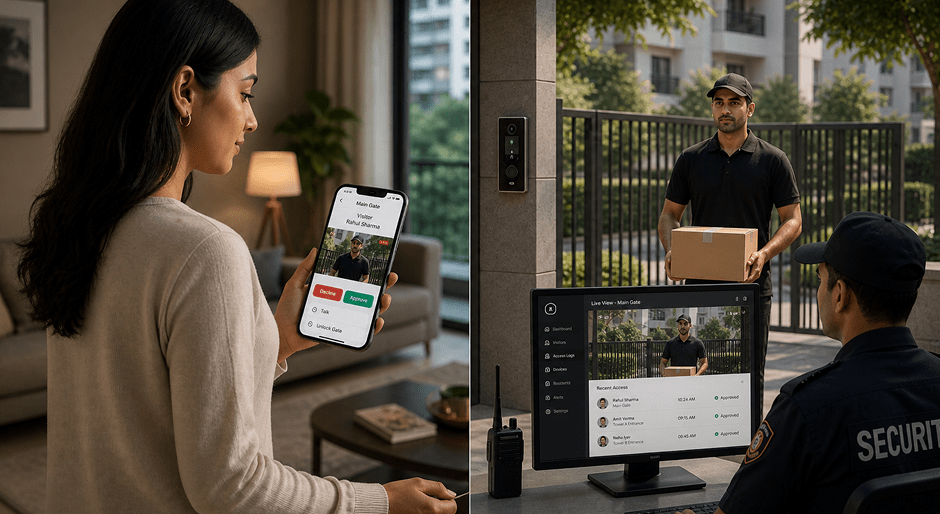
In gated communities, security consistently ranks as the top priority for residents. Yet, the way it is managed often feels out of sync with that expectation. A visitor arrives, a call is placed, a register is signed, and access is granted. It works, but just enough.
What residents want today is very different. They expect visibility before a call is made, control without physical presence, and a record without manual effort. In other words, they expect security to feel as seamless as the rest of their digital lives.
IoT-based smart access has the potential to enable this shift. But in many communities, it hasn’t – largely because it exists in silos. A camera has its own app. A smart lock has another. A video door phone sits on a separate interface. The technology is there, but the experience is fragmented.
The real transformation begins when these systems come together – when IoT is not just deployed but integrated into the platform residents already use. That is where IoT smart access solutions in residential communities moves from hardware to infrastructure.
The security gap in residential communities
There is a visible gap between what residents experience and what they expect. The expectation is simple: to know who is at the gate, to respond instantly, and to always feel in control of access. In practice, most interactions are still reactive with no visual confirmation and limited traceability.
This gap is not due to a lack of investment. Many communities have already adopted smart community security solutions, including IoT-based smart access, CCTV systems, access control, or video door phones. The challenge lies in how these systems are deployed. When each operates independently, they add layers of complexity instead of removing them.
As a result, residents navigate multiple touchpoints for a single outcome. Security teams manage parallel systems and developers struggle to deliver a consistent experience.
What IoT-based smart access looks like
To understand the shift, we have to distinguish between connected devices and connected systems.
A smart lock has its own app. Similarly, a video door phone will have a dedicated interface. But these remain isolated, siloed experiences. Integration changes the equation entirely.
When IoT smart access devices are connected to a central community management platform like ANACITY, they begin to operate as part of a larger system. Visitor pre-approvals can trigger access permissions at the gate. A live video feed can be accessed from within the same interface used for bookings or payments. Every interaction becomes part of a continuous, traceable workflow.
ANACITY brings together IoT-based smart access hardware, software, and user interaction into a single, unified experience. Through an open and scalable architecture, it connects multiple systems into one interface, ensuring that residents, security personnel, and community managers are all working within the same environment.
The result is a fundamentally enhanced residential experience.
A real-world view of integrated security
ANACITY’s IoT-based smart access integration creates an intuitive experience where residents are notified of every visitor entry, view them on the security camera, approve or deny access, pre-authorise visits, and manage frequent entries without repeated intervention.
Behind the scenes, multiple systems are working to bring together video door phones, CCTV networks, lobby access points, and smart locks. This integration removes the need to switch between applications or rely on manual coordination.
For community managers, the impact is equally significant. Access logs are unified and automatically recorded. Alerts are real-time and actionable. The dependency on paper registers and manual tracking is eliminated. What was once fragmented becomes structured and visible.
This is what proptech security looks like when it is designed around integration rather than individual features.
Beyond security: the next layer of integration
Security is often the first area where IoT is adopted, but it rarely remains the only one.
Once the physical and digital layers are connected, the same infrastructure can support a broader range of capabilities. Indoor air quality monitoring can provide real-time insights into living conditions. HVAC systems can be optimised based on usage patterns. Energy management solutions can improve efficiency across the community. Even EV infrastructure can be integrated into the same ecosystem.
What begins as a security upgrade with IoT-based smart access gradually evolves into a connected environment – one where data flows across systems, and decisions are informed by real-time insights.
ANACITY’s platform is designed with this evolution in mind. By enabling integration at the foundational level, it allows communities to expand from security-focused use cases to a more holistic, intelligent living experience.
The next decade of residential real estate will be shaped not by the number of technologies deployed, but by how well they work together. Communities that lead this shift will be those where infrastructure and interface are aligned where the physical environment and the digital platform operate as one.
This level of integration is no longer a future vision. It is already being implemented, quietly transforming how residents experience security, convenience, and control.
Learn how ANACITY’s open API architecture enables seamless integration with IoT-based smart access as well as other hardware systems and enterprise platforms – creating a truly connected community experience. Connect with us at support or call 8088611229. For global enquiries, write to us at sales@anacity.com or visit www.anacity.com.
i