In many residential communities, technology adoption has grown organically. A visitor management app here, a billing tool there, another platform for amenities, and yet another for communication.
On paper, this seems like digitisation. In practice, it often leads to fragmentation.
As communities scale and expectations rise, this patchwork approach begins to show its limits both operationally and financially. Increasingly, developers and management teams are moving toward a single, unified community management platform like ANACITY for convenience and measurable returns.
The problem with multiple apps
Using multiple tools for different functions creates hidden inefficiencies that compound over time. Some of these are:
- Operational complexity: Staff must switch between systems, duplicate data entry, and reconcile information across platforms. This increases the chances of errors and slows down response times.
- Poor user experience: Residents or occupiers are required to download and navigate multiple apps for payments, visitor approvals, service requests, or communication. Adoption drops, engagement weakens, and the value of digitisation is diluted.
- Lack of visibility: With data scattered across systems, management teams struggle to get a unified view of operations, making decision-making reactive rather than strategic.
- Escalating costs: Through multiple vendor contracts, integrations, maintenance overhead, and training requirements.
The shift to a unified platform
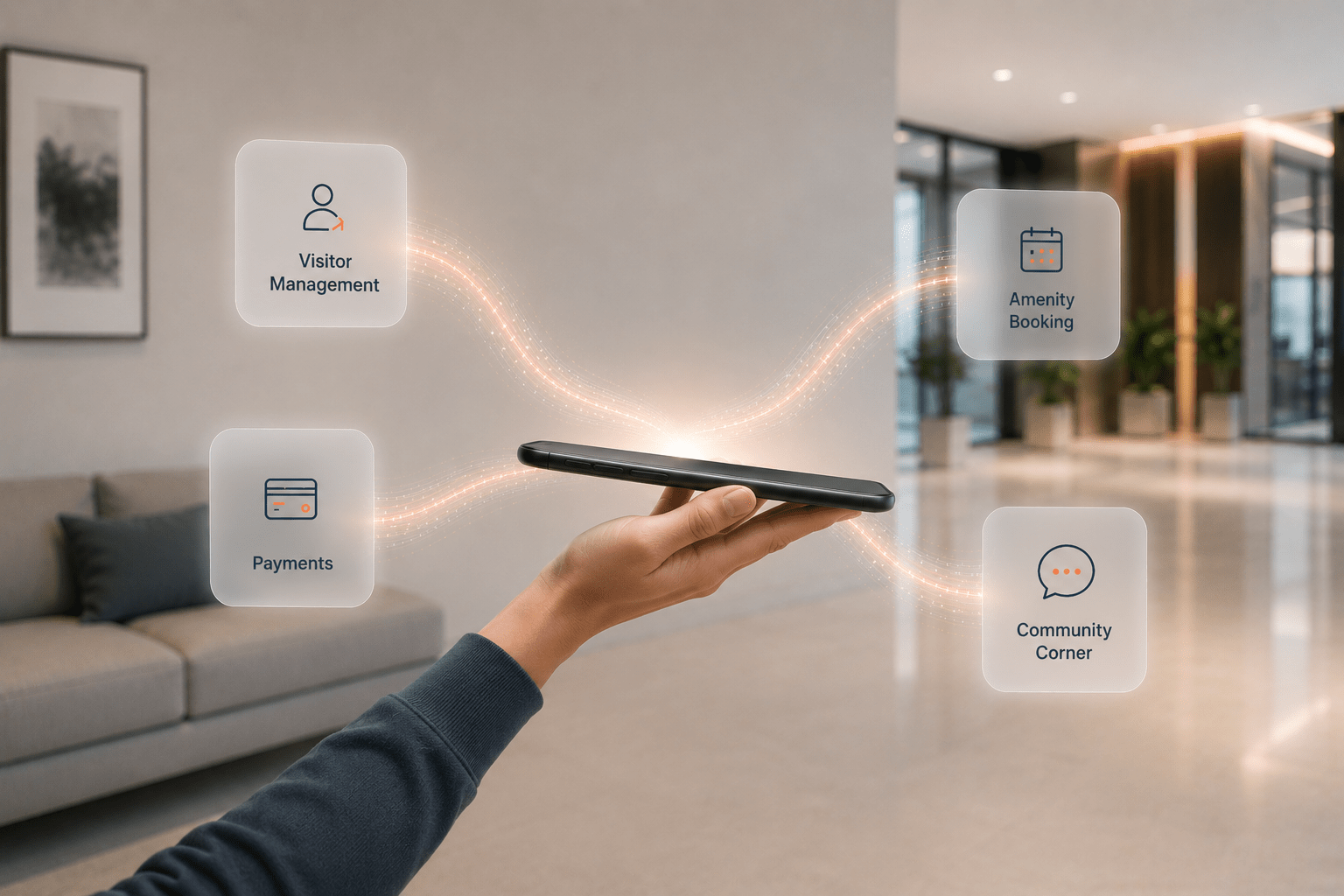
ANACITY a brings these fragmented workflows into a single, integrated ecosystem. Instead of separate tools, every feature and module, from visitor management and billing to amenities, to communication, and service requests, operates through one interface.
For residents, ANACITY becomes a single app for everyday community living while serving as a single source of truth for management teams.
Benefits of moving to one platform
There are multiple benefits of shifting to one platform, from operational efficiency to the establishment of a single source of truth.
Operational efficiency at scale
The integration of modules on a single platform ensures faster and more streamlined processes. Visitor approvals, maintenance requests, payments, and communication workflows are all connected. This reduces manual intervention, eliminates duplication, and improves turnaround times. This efficiency compounds significantly over time for large communities.
Improved user adoption and engagement
One of the biggest challenges in proptech is adoption. A unified platform simplifies the experience for residents and occupiers. Instead of juggling multiple apps, they interact with a single interface for all their needs – increasing the chances for platform stickiness.
Higher adoption leads to improved communication reach, faster approvals and responses as well as increased usage of community services.
Better data, smarter decisions
Data becomes centralised and actionable when all operations run through one platform. Management teams can track key operational and management data like:
- Visitor patterns and peak hours
- Service request volumes and resolution times
- Amenity usage trends
- Payment cycles and collections
This enables data-driven decision-making, improving both operational planning and long-term strategy.
Stronger security and compliance
Fragmented systems often create gaps in security. A unified platform ensures that access control, visitor logs, staff tracking, and incident reporting are all connected. This not only improves real-time monitoring but also strengthens audit trails and compliance readiness.
Cost optimisation and lower TCO
While multiple apps may seem cost-effective individually, the combined Total Cost of Ownership (TCO) is often higher. A single platform reduces:
- Vendor management overhead
- Integration and maintenance costs
- Training and onboarding time
- Redundant feature duplication
Over time, this leads to significant cost savings.
Understanding ROI: Beyond just cost savings
The return on investment from a unified platform goes beyond direct cost reduction. It reflects in both tangible and intangible gains.
Tangible ROI
- Reduced operational manpower requirements
- Faster billing cycles and improved collections
- Lower technology maintenance costs
Intangible ROI
- Higher resident satisfaction and retention
- Stronger brand perception for developers
- Better service delivery and responsiveness
For developers, especially, this translates into higher asset value and differentiation in a competitive market.
The strategic advantage
As gated communities and commercial spaces evolve into digitally connected ecosystems, the role of technology is no longer limited to enabling operations. It becomes central to shaping experience. A unified platform allows communities to scale efficiently while delivering consistent user experiences. ANACITY’s open architecture is also open to integration, enabling it to expand services more easily. In contrast, fragmented systems make scaling harder and innovation slower.
Moving from multiple apps to a single community management platform is a strategic shift and not just a technology upgrade. It simplifies operations, improves engagement, strengthens security, and delivers measurable ROI over time.
To learn how ANACITY’s open unified community management platform, connect with us at support or call 8088611229. For global enquiries, write to us at sales@anacity.com or visit www.anacity.com.
i