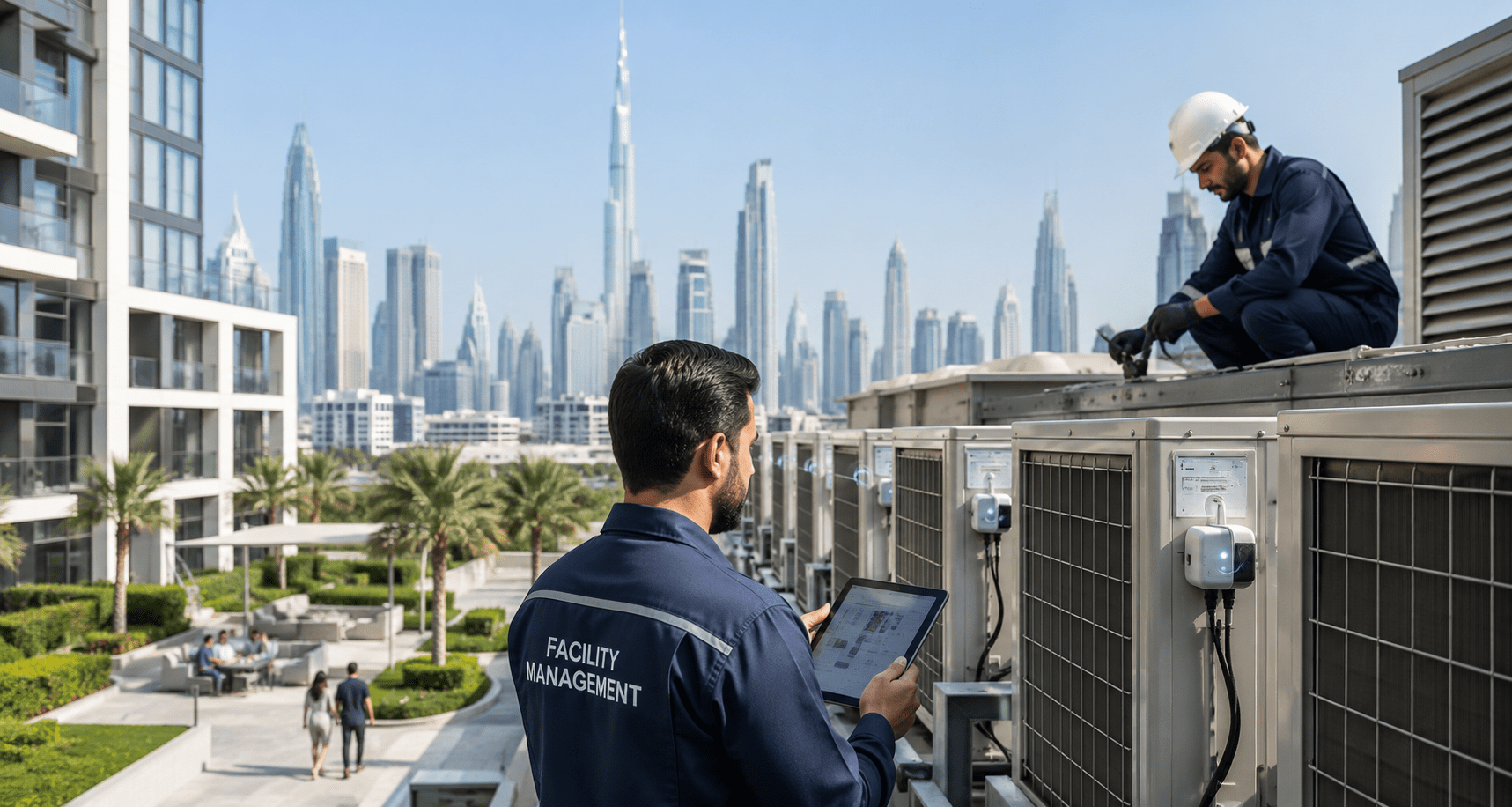
When an air conditioner fails mid-July in a Dubai residential tower, the consequences are not simply inconvenient. Emergency HVAC repair in that scenario can cost upwards of AED 50,000 once parts, labour and resident disruption are factored in. The scheduled maintenance check that would have caught the fault early costs a fraction of that figure. This is the core logic driving the rapid adoption of IoT predictive maintenance in residential buildings across the UAE – and it is a logic that is finally being taken seriously at the asset owner level.
From break-fix to anticipate-and-act
Reactive maintenance – the “run-to-failure” model – has long been the operational default in residential communities across the GCC. Before IoT and predictive maintenance reshaped the model, operational efficiency in property management sat below 45%, largely due to reactive maintenance and inefficient workflows. IoT sensors and predictive systems have pushed that figure to around 65–70%, while maintenance costs have dropped by up to 30%.
The mechanism behind this shift is straightforward. IoT sensors installed in HVAC systems, lifts, lighting and water pumps continuously collect performance data – temperature, vibration, energy usage – which is transmitted to a centralised platform where AI models detect anomalies and predict when maintenance is required before failure occurs, triggering automated alerts and enabling proactive scheduling.
For a residential facility team managing 500-plus units, that kind of continuous monitoring is structurally impossible to replicate with periodic manual inspections.
The UAE context makes this urgent
The UAE’s climate is not a minor variable. HVAC systems carry a disproportionate share of the operational load in residential buildings, and the cost of failure during peak summer months is compressive – on budgets, on resident satisfaction and on service charge credibility. The UAE smart HVAC controls for buildings market was valued at USD 1.2 billion in 2025, driven by the government’s target to reduce national energy consumption by 30% by 2030.
The policy environment is actively accelerating adoption. The Dubai 2040 Urban Master Plan carries smart infrastructure targets across five urban centres, and Dubai ranks 4th on the 2025 IMD Smart City Index, with a target to have 30% of all buildings classified as “smart” by 2030 under its Clean Energy Strategy. For residential developers and asset owners, this is less a future aspiration and more an incoming compliance baseline.
What the Data Says
IoT predictive maintenance in residential buildings is not speculative – there is a measurable returns case. A McKinsey analysis found that early adopters of IoT and AI-based maintenance reported repair cost reductions of up to 25% and maintenance downtime cut by nearly 50%. On the resident retention side, an Emirates Property market analysis revealed that early adopters of comprehensive management platforms saw tenant retention rates 32% higher than the market average.
These numbers matter because service charge disputes and RERA complaints in Dubai are, in no small part, driven by poor maintenance responsiveness. When facility teams can document exactly when a fault was detected, what action was taken and how quickly it was resolved, the conversation with residents and regulators shifts entirely. Platforms like ANACITY, which connect IoT-enabled facility operations with resident-facing apps, illustrate how asset owners are beginning to close that loop – tying predictive maintenance workflows directly to occupant communication and compliance records within a single ecosystem.
The integration challenge that still needs solving
The technology itself is no longer the primary obstacle. The real challenge is systems integration – property managers often operate multiple disconnected platforms, and bolt-on IoT.
With its open architecture, ANACITY integrates seamlessly with IoT devices, creating a unified operating layer. To learn how ANACITY’s unified community management platform, connect with us at sales@anacity.com or visit www.anacity.com.
i