 The workplace is becoming smarter. Buildings are adopting IoT devices, AI is entering operational workflows, and digital tools are increasingly shaping how employees interact with their work environment.
Despite these advancements, many workplace ecosystems remain fragmented. Employees use different platforms for visitor approvals, meeting room bookings, and workplace communications. While each tool may solve a specific problem, the overall experience often feels disconnected. This is why the future of workplace technology is about creating connected experiences.
The shift from smart buildings to smart experiences
For years, workplace innovation focused on individual technologies.
Organisations invested in access control systems, helpdesk platforms, room booking tools, workplace apps, and building management systems. While these technologies improved operational efficiency, they often operated independently of one another.
Today’s challenge is different. Employees no longer evaluate technology based on individual features. They evaluate the workplace based on how easily everything works together.
A visitor invitation should connect to access management. A meeting room booking should integrate with workplace services. A facility request should be visible across operational teams without requiring manual coordination.
Employees increasingly prefer workplaces where experiences flow seamlessly across systems.
Future of Workplace Technology Is Connected
Employees form opinions about a workplace through hundreds of daily interactions. From entering the building and booking amenities to raising requests and receiving updates, every touchpoint contributes to the overall workplace experience.
When these interactions are disconnected, friction increases. Employees spend more time navigating systems, searching for information, and following up on requests. Operational teams, in turn, spend more time coordinating between platforms and managing manual processes.
Connected workplace technology removes these barriers by bringing together services, communication, access, operations, and engagement within a unified ecosystem.
The result is a workplace that feels simpler, faster, and more intuitive, leading to higher employee satisfaction. Research shows that employee satisfaction is directly linked to their retention – a key factor for tenanted offices.
Data becomes more valuable when systems are connected
One of the biggest advantages of connected workplace ecosystems is the quality of data they generate. When systems operate independently, organisations see isolated data points for functions like access logs, visitor records, helpdesk tickets, amenity bookings, and employee engagement metrics.
However, when these systems are connected, a much richer operational picture emerges. Organisations can identify workplace usage patterns, understand employee behaviour, measure service performance, and make more informed decisions about workplace design and operations.
This connected data foundation is also what enables future AI-driven insights and automation.
The role of AI in the future of workplace technology
Artificial Intelligence is expected to play an increasingly important role in workplace operations. AI can help predict maintenance requirements, identify operational bottlenecks, personalise employee experiences, and improve resource allocation.
However, AI is only as effective as the data it receives. Disconnected systems create fragmented data. Connected ecosystems create context.
As a result, organisations looking to adopt AI successfully must first focus on building a connected digital foundation.
Building the workplace of tomorrow
The most successful workplaces of the future will not necessarily be those with the most technology. They will be the workplaces where technology works together to create seamless experiences for employees, visitors, facility teams, and administrators.
It requires moving beyond standalone applications and towards integrated workplace ecosystems that connect people, spaces, services, and operations.
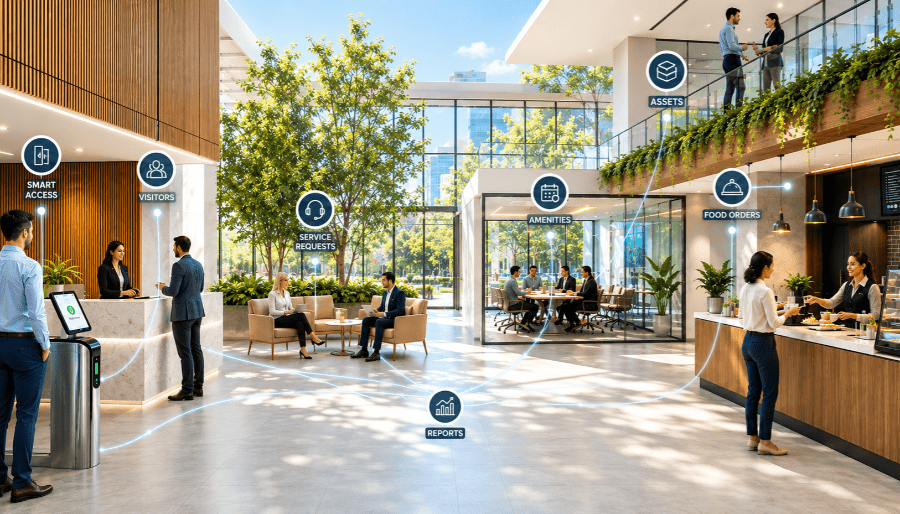
ANACITY Business brings together workplace access, visitor management, helpdesk operations, amenities, engagement, food services, and analytics into a single connected platform. It is defining the future of workplace technology by facilitating organisations to deliver a better employee experiences while gaining deeper operational visibility.
Connect with to find out more about the future of workplace technology. Write to us at support or call 8088611229. For global enquiries, write to us at sales@anacity.com or visit www.anacity.com.
i