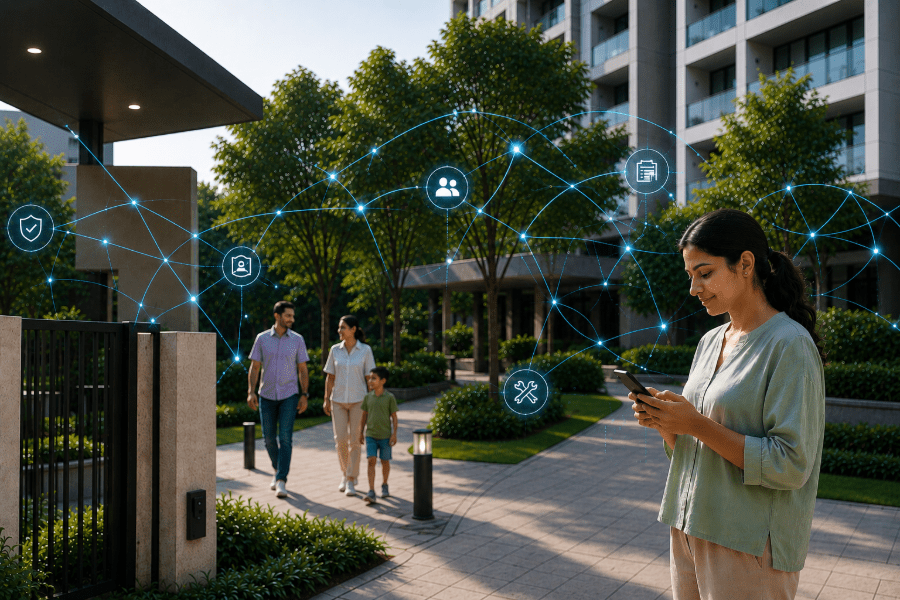
Community management has undergone a major digital transformation over the past decade. From visitor management and digital payments to facility booking and resident communication, technology has fundamentally changed how residential and commercial communities operate.
But the next evolution may not just be digital. It may be intelligence with Artificial Intelligence (AI) for community management.
AI for community management
As conversations around AI continue to accelerate globally, the real estate and community management industry is beginning to explore what AI-driven operations could look like in everyday environments. While AI adoption in communities is still at an early stage, its potential is already reshaping expectations around efficiency, responsiveness, and user experience.
The future of community management may no longer be defined only by automation but by systems that can anticipate needs, identify patterns, and enable faster decision-making.
This shift mirrors what is already happening across industries such as finance, logistics, healthcare, and retail where AI is helping organisations become more proactive, data-driven, and operationally intelligent.
How AI is redefining community management
Modern communities generate enormous amounts of operational data every day including visitor entries, maintenance requests, amenity bookings, energy usage, complaints, staff attendance, occupancy patterns, and engagement activity. Traditionally, most of this information has remained fragmented across multiple systems and dashboards.
AI for community management changes the equation by introducing the ability to analyse these large datasets at scale and extract actionable insights from them.
Instead of only reacting to issues, communities could gradually move towards:
- Predictive operations
- Smarter resource allocation
- Faster response systems
- Personalised resident experiences
- More efficient facility management
From operational management to intelligent ecosystems
Historically, community management platforms were designed primarily as workflow tools. Their purpose was to digitise manual tasks such as visitor approvals, complaint tracking, billing and collections, staff management, communication, and announcements.
The next phase may involve transforming these systems into connected operational ecosystems capable of generating intelligence from daily activity. For example, repeated complaints in a particular zone could help identify recurring infrastructure issues. Similarly, occupancy insights could improve energy and facility efficiency.
In this model, AI for community management does not replace operations teams. Instead, it enhances visibility and supports better decision-making.
The future of resident experience
One of the biggest areas where AI could influence community management is resident experience.
Today’s residents increasingly expect the same level of digital convenience from their communities that they experience in banking, e-commerce, or mobility apps. Expectations around responsiveness, convenience, and personalisation continue to rise.
In the future, AI-enabled community platforms could potentially:
- Simplify support through intelligent assistance systems
- Improve response prioritisation for complaints and requests
- Enhance safety through anomaly detection and predictive alerts
- Recommend relevant services based on resident behaviour
- Personalise notifications and communication
This creates the possibility of communities becoming more adaptive and responsive to resident needs over time.
AI and the future of facility & security operations
AI also has significant implications for backend operations. Facility management teams often deal with large volumes of repetitive operational tasks that require constant monitoring and coordination. AI-driven analytics could help identify patterns that may otherwise go unnoticed.
Potential future applications may include:
- Predictive maintenance based on asset performance trends
- Smart monitoring of ticket escalations and response delays
- Security intelligence based on movement and access patterns
- Automated operational reporting and insights
As buildings become more connected through IoT devices, access control systems, and smart infrastructure, AI for community management could play a larger role in helping teams manage increasingly complex environments more efficiently.
The importance of digital foundations
While AI presents significant future opportunities, intelligent operations are only possible when strong digital foundations already exist. Before communities can leverage AI effectively, they first need:
- Digitised workflows
- Centralised operational visibility
- Integrated systems and data
- Consistent user engagement
- Connected digital ecosystems
In many ways, AI for community management is not the starting point – it is the next layer built on top of an already connected operational environment.
This is why the broader industry focus today continues to remain on creating scalable digital ecosystems that unify people, operations, services, and infrastructure. Find out why AI in Real Estate Starts with Connected Digital Ecosystems.
The shift towards data-driven communities
The future of community management is likely to be shaped by a larger transition happening across real estate itself – from intuition-led operations to data-led ecosystems. Read Leveraging Data to Improve Lives in Gated Communities.
As communities become larger, denser, and more operationally complex, decision-making will increasingly rely on visibility, analytics, and predictive insights rather than manual coordination alone. AI will likely accelerate this transition by enabling:
- Faster operational intelligence
- Better forecasting
- Improved resident engagement
- Smarter utilisation of infrastructure and services
Over time, this could fundamentally redefine how communities are managed, experienced, and scaled.
Looking Ahead
AI for community management is still an emerging conversation, but its long-term implications are difficult to ignore. For real estate developers, operators, and technology platforms, the opportunity lies not only in adopting AI tools, but in building the connected digital ecosystems that make future intelligence possible.
i